
By Nicole Guether
Shaped by the most fashionable and ill-fated queen in history
The unluckiest of all queens revolutionised the fashion of her time by boldly (or perhaps boredly) challenging tradition. Among other things, she introduced the so-called English Dress at court, which featured elements borrowed from men’s fashion, such as short jackets, wide lapels, and long sleeves. Marie Antoinette sourced inspiration from various courts, created her legendary style, and set significant trends. A fashionista avant la lettre, she would probably be an influencer today.
Her style continues to ignite the imagination of designers and stylists, who find themselves in dizzying heights of inspiration – as if only women and men could still be dressed up so outrageously like back then!
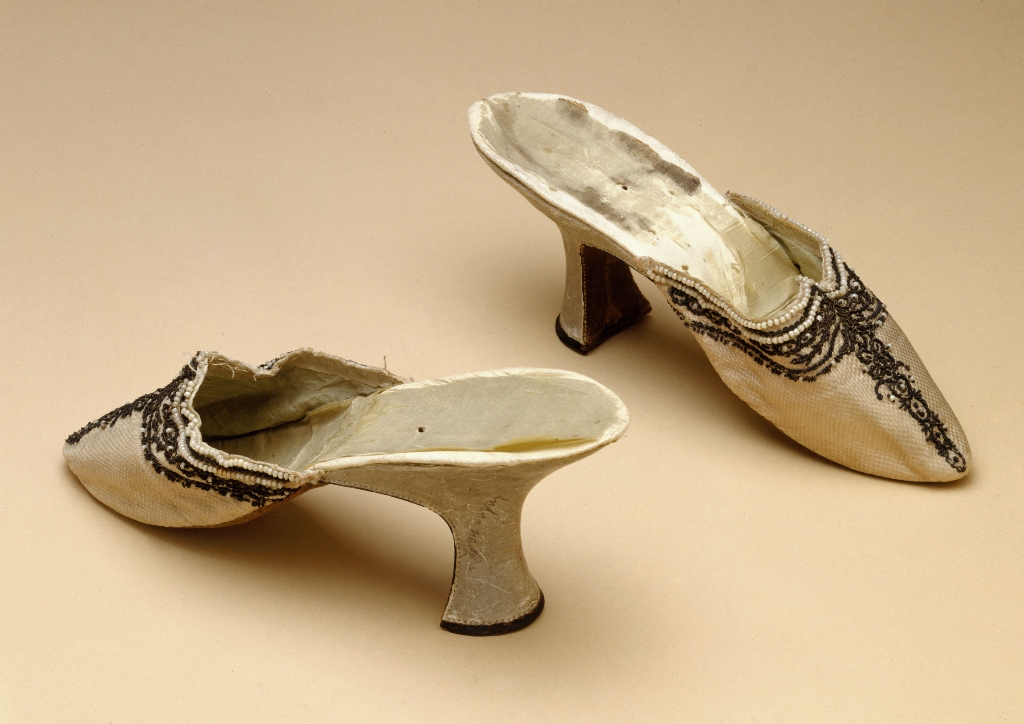
Illustration 1
It is said that one should walk in someone else’s shoes to understand them fully… Those shoes aren’t really made to walk in: Slippers of Marie Antoinette, pearl-embellished pink silk, undated © V&A Museum, London (Musée Carnavalet, Paris)
Fashion for Distinction and as Personal Statement
The unfortunate French queen (1755–1793) of Austrian-Habsburgian origin is the true dazzling figure of her era. Yet, the style of that period is named after her dull husband, Louis XVI. (Louis Seize in French). Rightly questioned so by the V&A, it is therefore concluded, more appropriate would be in fact „Marie Antoinette Style“. Is this an attempt to rewrite bias history, which was once written only by men?!
Because if the pale king had not lost his head so dreadfully, would he even be remembered at all? The young queen, sent at just fourteen years young to the foreign court as the bride of the equally young Dauphin, at least dared to enact her own small rebellion within the rather small limits.
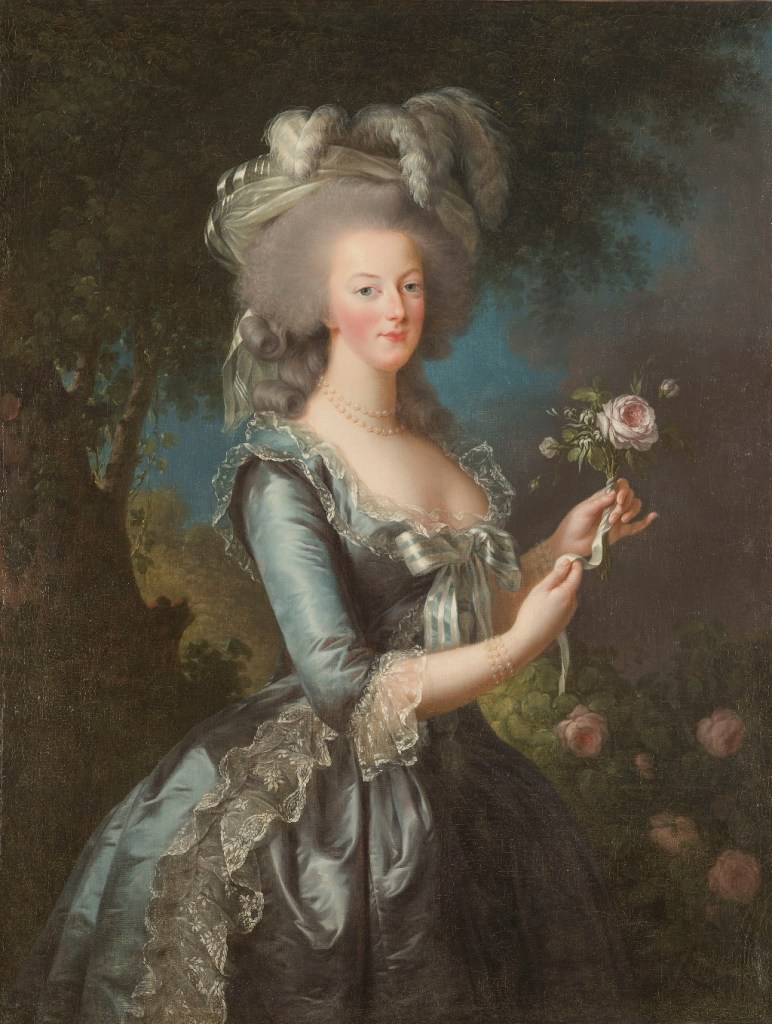
Illustration 2
Portrait of Marie Antoinette, Élisabeth-Louise Vigée Le Brun, 1783 © V&A Museum, London (Château de Versailles)
Opulent Staging
Just as Marie Antoinette’s taste was exquisite, so too is the design of the exhibition sponsored by luxury shoe manufacturer Manolo Blahnik. It shifts between elegant, pompous, and frivolous, all undeniably extravagant and of the highest quality. Sometimes historically more serious, at others aligned with current runway aesthetics, the exhibition traces her life through her evolving style.
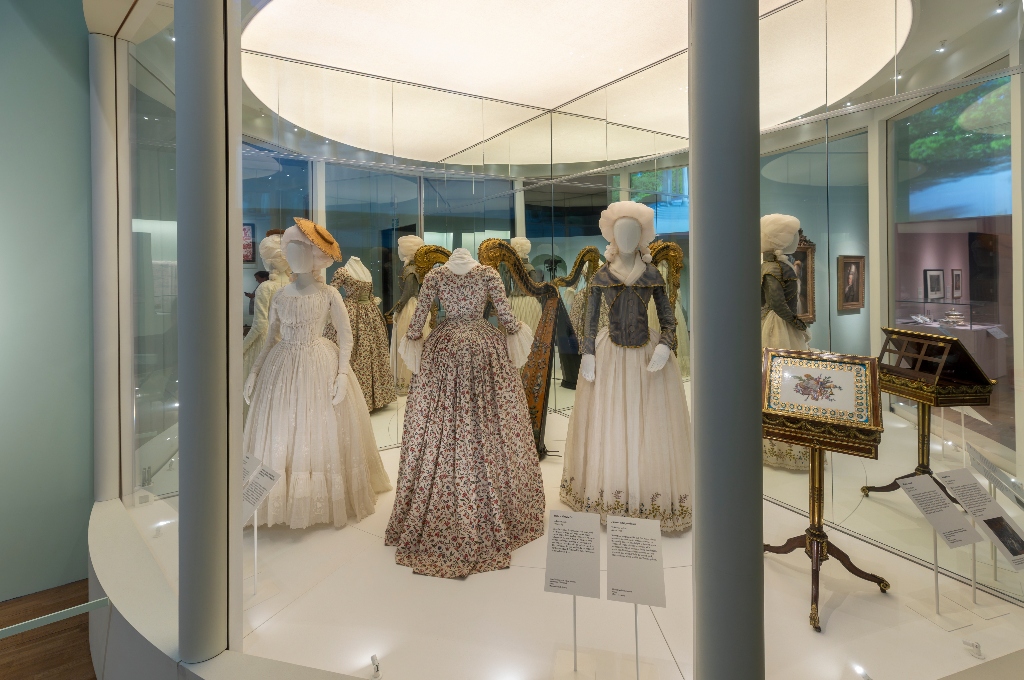
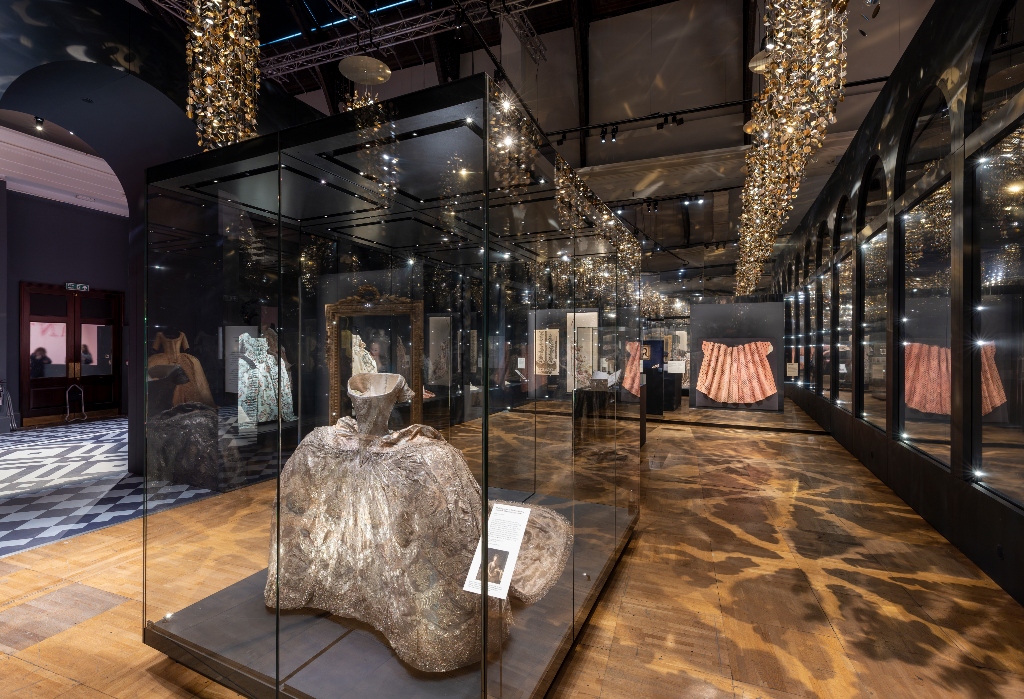
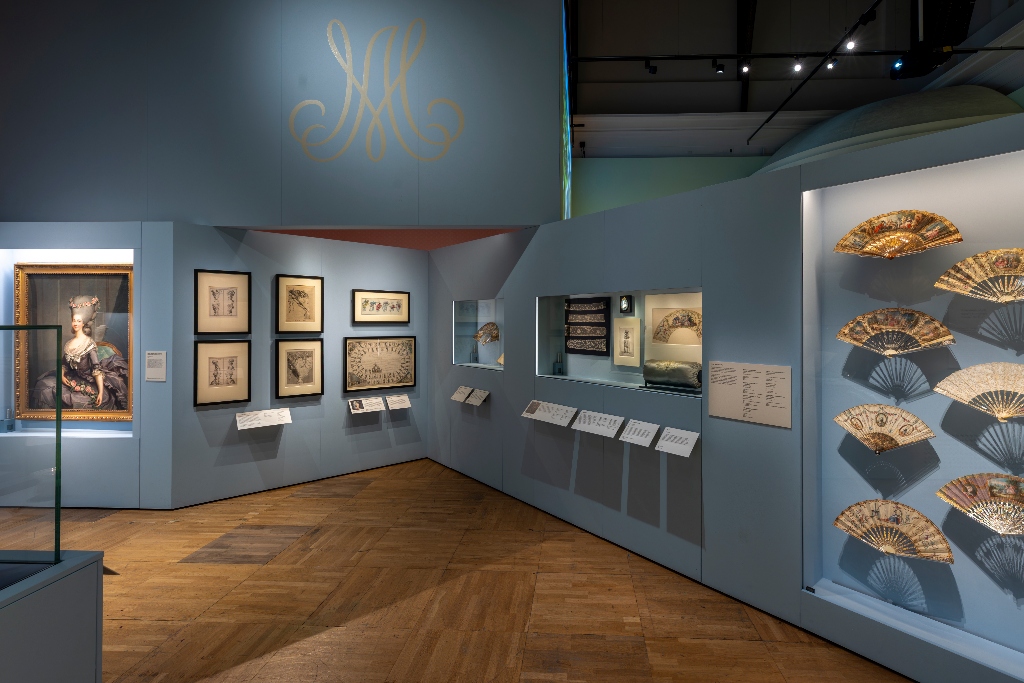
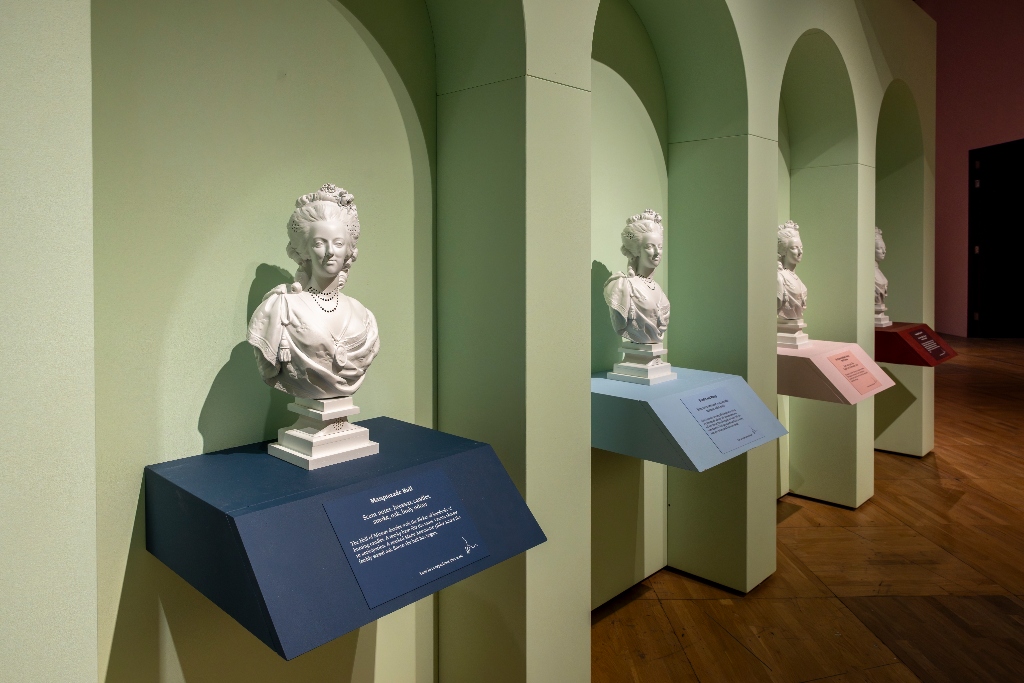
Images 3–6
Views into the Exhibition
© Victoria and Albert Museum, London (13) (7) (11) (12)
The introduction features in the trendy fashion colour of her time, strawberry blonde (or puce the French word for flea). Visitors are confronted with several of her portraits, ranging from a more intimate of the young princess to a representative state portrait showing her in court dress with a crown at her side (Élisabeth Louise Vigée Le Brun, 1783) – precisely the areas between which her life was to unfold.
A famous quote from her mother, Empress Maria Theresa, is displayed as a life-defining motto: „All eyes will be on you“ – meant as a warning in 1770 when the then fourteen-year-old was betrothed to the French heir. This prophecy would prove true, even until her brutal public ending on the scaffold at Place Louis XV (today Place de la Concorde). Morbidly, the (presumed) guillotine is also exhibited.
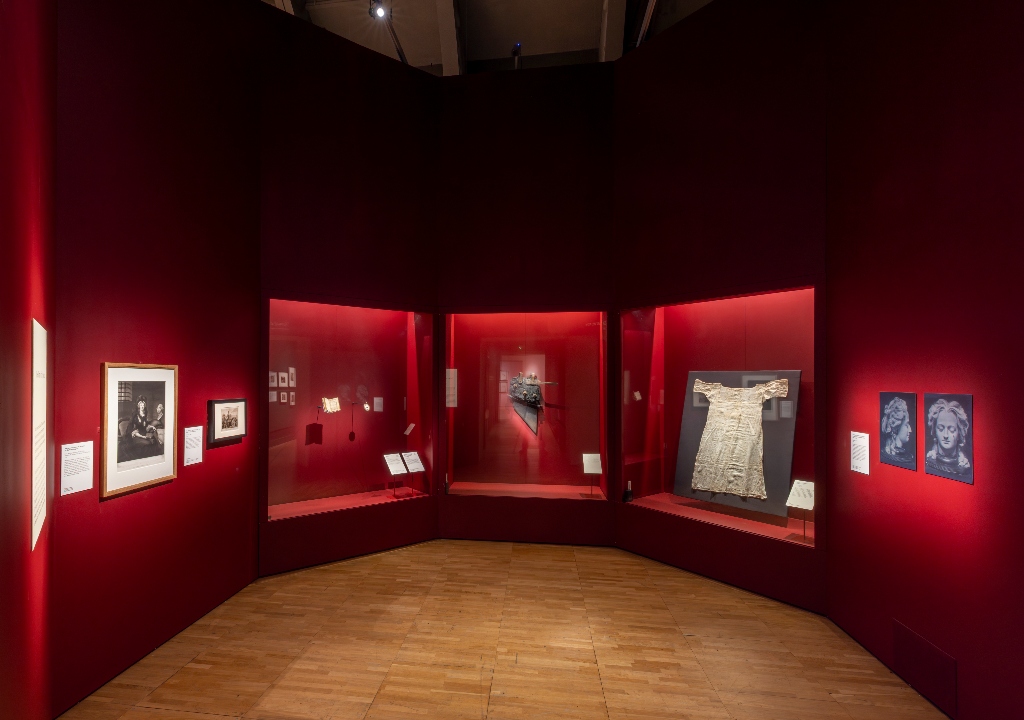
Illustration 7
Rather Morbid: The (presumed) guillotine is also on display. It is said that Mme Tussaud’s son received it personally from the executioner’s son.
© Victoria & Albert Museum, London (14)
A life under constant surveillance, just as the rigid court etiquette dictated. In later years, Marie Antoinette increasingly withdrew from it into her architectural retreats, as well as into her extravagances in splendour and her obsession with excessive toilette.
The second room marks a first exhibition’s highlight: floor-to-ceiling black walls, sparkling “chandeliers”, spherical music filling the space. At its centre, in an exorbitant vitrine, is a silver-twined wedding dress, similar to what Marie Antoinette had worn – those surprised by the petite size should remember that these were children being married off.
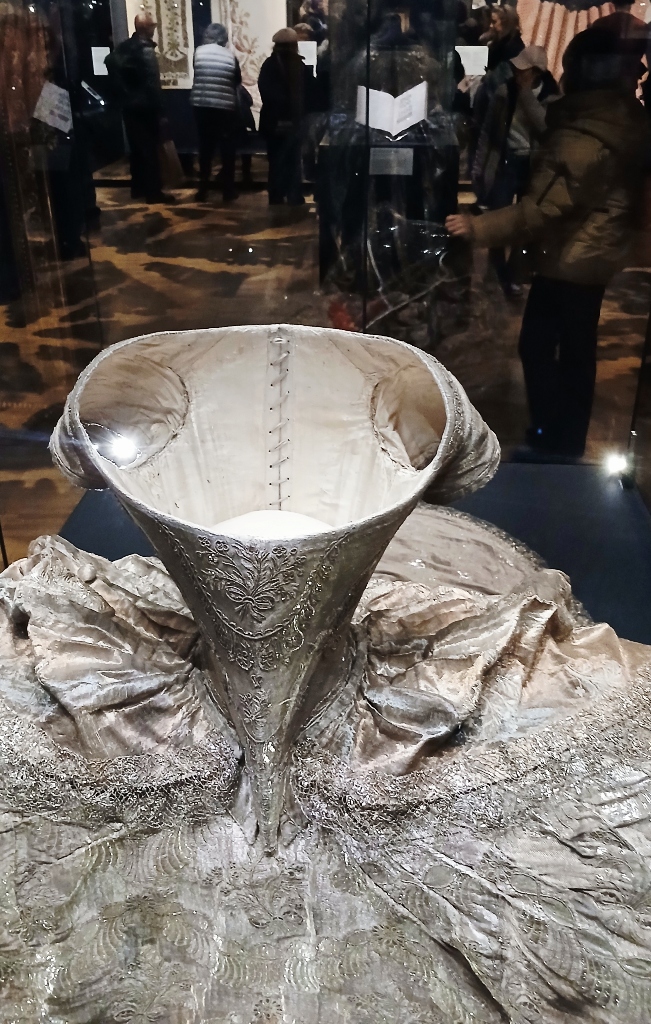
Illustration 8
For those surprised by the petite size should remember that children were being married off … (Photo: Nicole Guether, 2026)
„More“ than a Queen: Early Celebrity and Fashionista, or: A Life of Superficiality
With her obsession for diversion and fine things, Marie Antoinette created entire industries and laid the groundwork for France as a modern hub of luxury until today. Because only the best was deemed good enough for the upper ten thousand.
The following rooms display many beautiful trivialities which had filled her days and nights: dressing tables and seating furniture, jewellery, loads of them, handcrafted trinkets of the highest quality, knick-knacks and curiosities such as a breast cup based on ancient myth, lace and fabric designs, fans, and sketches for sculptural hair monstrosities which were trend at the time, a copy of the then-best-selling novel Les Liaisons Dangereuses (1782), which she was known to have owned, defamatory pamphlets from the declining years, and finally dresses inspired by her timeless style.
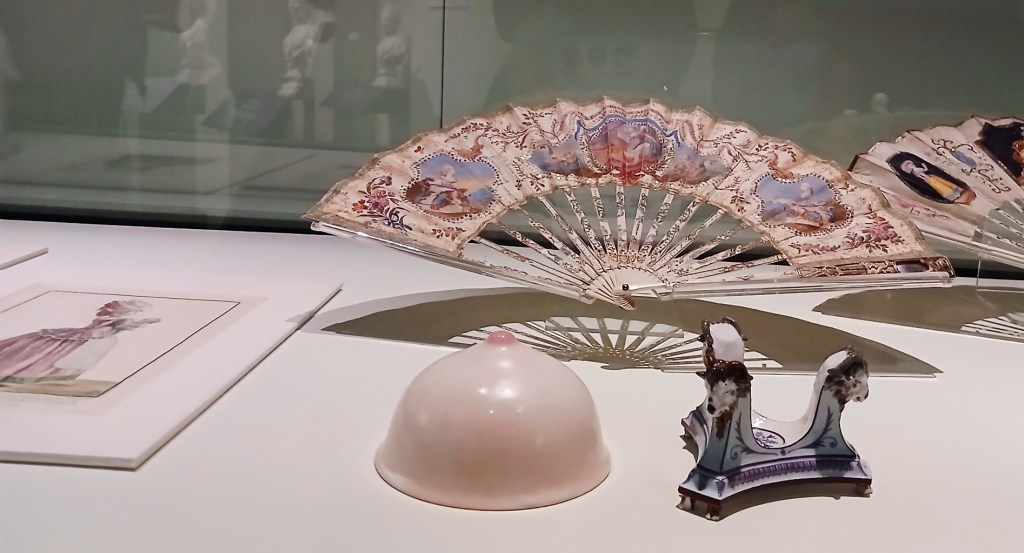
Illustration 9
Curiosities such as a breast cup are based on an ancient myth (Photo: Nicole Guether, 2026)
In the repetition of the myriads of diamond bows – despite its hypnotic sparkle – I couldn’t help but wonder: why is one person ever in need of more and more of the same? Marie Antoinette evidently did not gain perfect happiness with this excess, did she?
Let them look at exhibitions when the world is falling apart!
How we perceive an exhibition depends on the individual context – just as exhibitions, conversely, are influenced by external circumstances.
The problem with this exhibition is that it cannot decide whether it aims to be a biographical overview illustrating her life through references of fashion, or a show about a style and its afterlife.
However, since this fashion exhibition links itself to biographical moments, it’s superficiality becomes apparent, much like the life Marie Antoinette had complained about. The insertion in crimson red, when addressing the queen’s violent end under the guillotine, is entirely misplaced, as if it were necessary. All the while it surely is primarily meant as a bridge to the epilogue, the afterlife of Marie Antoinette’s style through the rediscovery several decades after the events of revolution, terror, Napoleon, and restoration.
Just because everything of that time is in one way or the other stylistically tied to the period, does not make it a value object for the exhibition’s thesis of the queen’s influence, it rather reveals a lack of context.
All the more superficial, then, feels the ending, an explicit indulgence in fashionable extravaganzas – designed for social media likes. Fashion as mere surface, when the initial thesis was that fashion was the one domain where Marie Antoinette found a semblance of freedom.
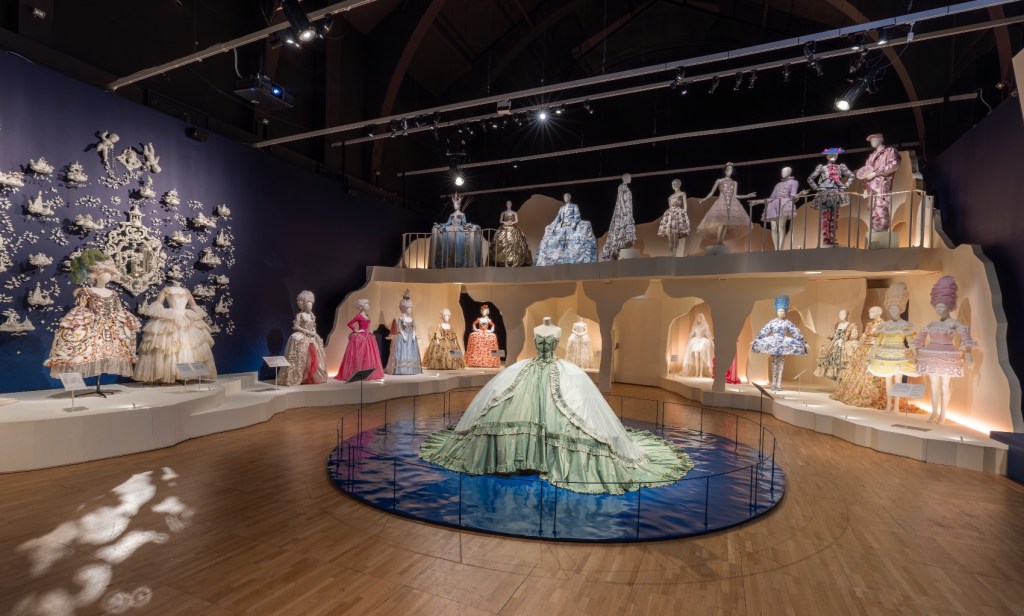
Illustration 10
Final room of the exhibition: obviously an impressive display of fashion extravaganza
© V&A Museum, London (19)
If one engages with the persona of Marie Antoinette, as scholars have thankfully done in recent decades, one realises that she, despite her undeniable tendency towards boredom, also possessed other qualities. If Marie Antoinette had been allowed a bit more than just adornment, perhaps history would have taken a different turn.
Why now a fashion exhibition about the ill-fated French queen?
Decadence is a defiant form of luxury in times of crisis, when the upper class still indulges in their resource-intensive luxuries that they probably should no longer afford given widespread hardship. But when the elite has become so detached from the rest, or at least the detachment becomes blatantly obvious, then the blinkers are tightened even more. Double plus good, so to speak. Then, all the more, they celebrate and believe that individuals are truly architects of their own happiness, and if things are going really well, then one certainly must have earned it.
This exhibition strikes me as a giant blinker of Great Britain in 2025, a country, nevertheless, like many others worldwide, battling numerous crises. Culture as mere escapism and flight from reality. We are meant to blindly flee our worries, just as Marie Antoinette did, turning a blind eye to the hunger outside the palace gates. And it appears to work: on the day of my visit, tickets were sold out completely, and the less noble, well-dressed visitors inside seemed visibly impressed and, therefore, distracted.
Conclusion: “We have dreamt a pleasant dream, that’s all.” (Marie Antoinette, February/March 1793)
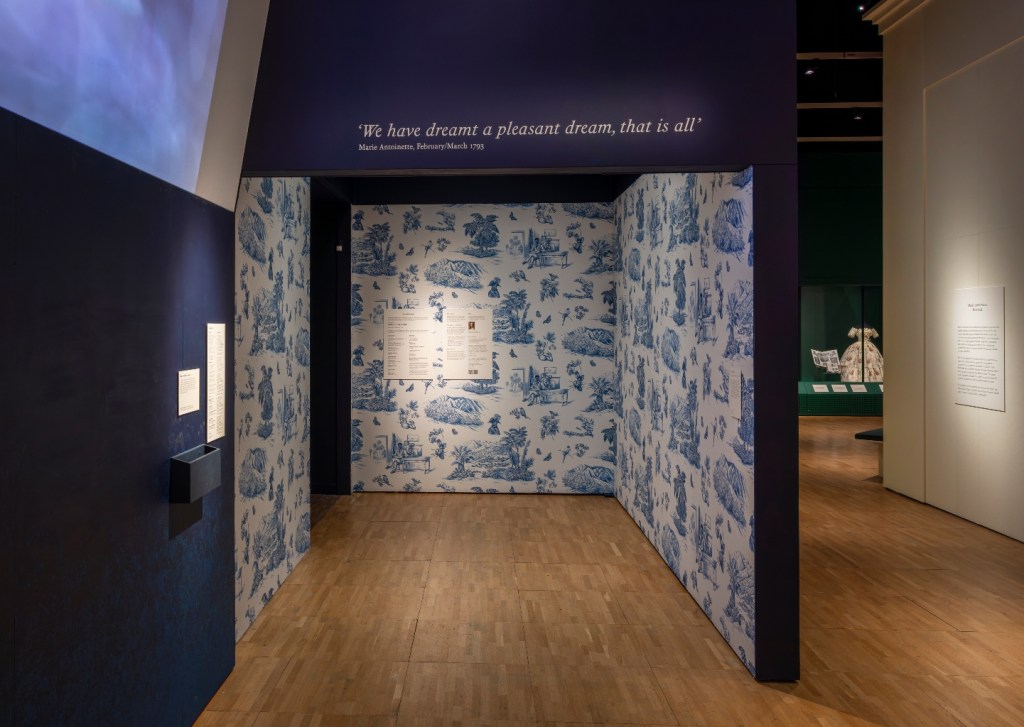
Illustration 11
Exit of the exhibition given the final word to Marie Antoinette
© V&A Museum, London
The exhibition on the life and style of France’s queen impresses with its sophisticated design – ironically, on closer look, signs and panels are already crumbling down; the surface peels where attention wanes.
It is regrettably, the curators were too blinded by their beautiful objects, much like Marie Antoinette herself, succumbing to uncritical presentation. This might would have been acceptable had they opted for a purely fashion exhibition. But since they included the (tragic) aspects of her life, the exhibition overindulges in superficiality, refusing critical reflection and thus falling into glossy illusion.
A Fatal Repetition!
Marie Antoinette and her court adorned themselves with countless carats of diamonds and expensive fabrics night after night, while millions lacked enough to eat or proper clothes – just a few kilometres from the golden gates of the magnificent cage in which the queen and her entourage resided. And today, an exhibition in South Kensington flaunts the diamonds of the dead, demonstrating that designers and stylists, just like in those days, would rather drape pretty ladies in the most splendid cloths as if nothing were amiss!
One might ask: is this the right time – with these ongoing crises – to indulge so readily in the lavish ostentation of a monarch so detached from reality? Can we afford to look at history so judgment-free?
All these beautiful objects have come down to us for admiration and wonder, but after the many lessons of history we could learn from, this thoughtless display leaves a bitter taste. Do art and culture truly bear no other responsibility than self-preservation to demonstrate superficial beauty? Unfortunately, it seems like a nostalgic digression into a “good old days” that were never truly good.
Exhibitions also tell us something about their very own context. Here, the beauty of fabrics and designs, precious jewellery and gemstones and craftsmanship is celebrated as if the suffering and injustice just outside the museum, which still bears the scars of the “Blitz” on its façade as a memorial to this day, do not exist. It renews an escape into extreme luxury from the inevitability from one’s own reality – even though only borrowed by the admission ticket.
A little more acceptance of reality would do us good at all times.
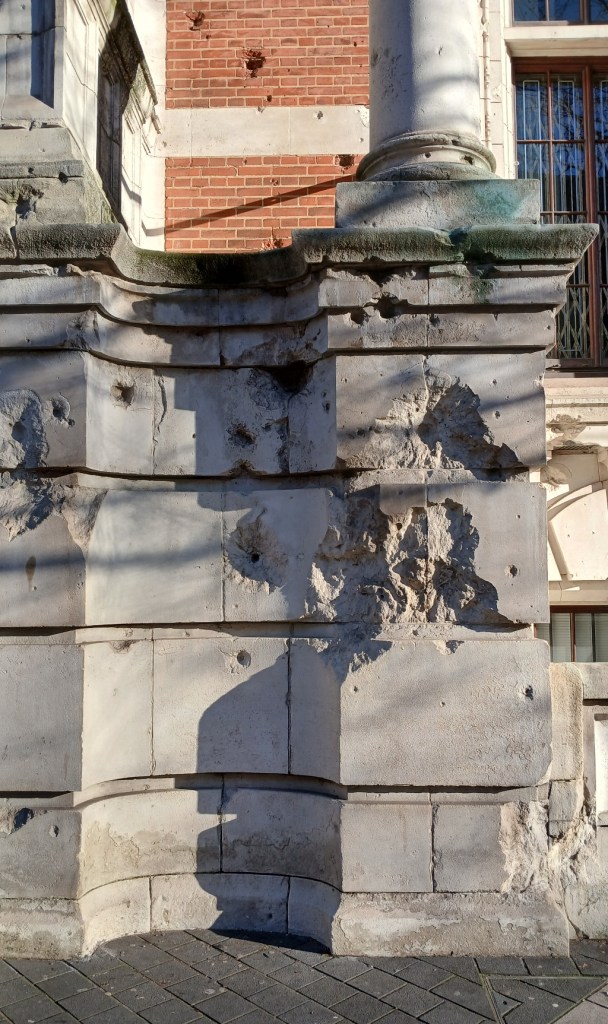
Victoria and Albert Museum, Facade (Photo: Nicole Guether, 2026)
„Marie Antoinette Style“ in the V&A Museum South Kensington until March 22, 2026
Curator: Sarah Grant
Exhibition Research Assistant: Helena Cox
Exhibition Design: OMMX
„This exhibition has been made possible as a result of the Government Indemnity Scheme. The V&A would like to thank HM Government for providing indemnity and the Department for Digital, Culture, Media and Sport and Arts Council England for arranging indemnity.”
Sponsored by Manolo Blahnik
Nicole Guether, 2026
*Thanks to the V&A press office for kindly granting permission to use the images; all image rights belong to the V&A Museum London, unless stated otherwise.
This review was first published in German language on: https://ausstellungskritik.blog/2026/01/23/marie-antoinette-style-von-nicole-guether/
Entdecke mehr von nicoleguether
Melde dich für ein Abonnement an, um die neuesten Beiträge per E-Mail zu erhalten.
